
Sofa Sectionals: The Complete Buyer's Research Guide
Compare L-shaped, U-shaped, modular, reclining, and sleeper sectionals. Learn how to measure your room, pick the right upholstery tier, and plan a layout that seats everyone comfortably before you commit.
Explore Recommended SectionalsWhy this guide exists: If you have already narrowed your search to sofa sectionals, the remaining decisions are configuration, fabric, seating depth, and clearance. This page walks through each in plain language so you can compare models on equal terms and buy with confidence.
What Exactly Is a Sofa Sectional?
A sofa sectional is a seating system made of two or more joined segments arranged at an angle, most often forming an L shape. Unlike a single straight sofa, a sectional wraps a corner and creates a natural conversation zone. The corner wedge is the defining piece — it is what turns a linear seat into an enclosed seating area.
Sectionals range from compact two-piece small L-shaped sofa designs for apartments to expansive pit configurations for open-plan family rooms. Because the segments connect, the total seating capacity is higher than a standard sofa of the same wall length, which is why they are the default choice for living rooms used for both lounging and entertaining.
If you are still weighing a sectional against a straight sofa and an accent chair pairing, the decision usually comes down to room geometry. A sectional follows the walls; a sofa-plus-chair setup follows the focal point. Rooms with one long wall and an open corner favor sectionals, while narrow rooms with two facing walls often work better with a straight frame plus a matching sofa and chair.
Sectional Configurations Explained
The configuration you choose determines how many people can sit, how the room flows, and how easy the sofa is to deliver. Below are the main families you will encounter while comparing models.
L-Shaped Sectional
The workhorse layout: one long run plus a shorter return at 90 degrees. Fits most medium living rooms and defines a corner without closing off the room.
U-Shaped Sectional
Two returns plus a long run enclose the seating area. Best for large rooms, media walls, and homes that host regularly. Needs generous floor space.
Modular Sectional
Individual seat, corner, and chaise modules clip together. Reconfigure for a new floor plan, split into separate seats, or extend later.
Chaise Sectional
A shorter run with an extended chaise for leg support. Excellent for small rooms that still want lounging space without a full return.
Left-arm and right-arm orientation matters more than most buyers expect. Stand at the room entrance facing the sofa: the chaise or return should sit on the side that follows your wall. If the return would block a doorway or walkway, flip the orientation. Many modular lines let you reverse the chaise after delivery, which is useful in rental apartments where you may rearrange later.
For larger spaces, a sectional with two chaise lounges doubles the lounging capacity without adding a recliner mechanism. For homes that need overnight guests, a sleeper sofa sectional combines the seating footprint with a fold-out bed.
How to Size a Sectional for Your Room
Most sectional returns are because the sofa did not fit through a door, around a stair turn, or into the planned corner. Measure these four things before you buy:
- Longest wall run: the maximum straight length available for the main sofa segment.
- Return length: how far the chaise or second segment can extend into the room without blocking traffic.
- Walkway clearance: aim for 30–36 inches on main paths and at least 18 inches between the sofa and coffee table.
- Entry path: door width, hallway turns, elevator depth, and stair ceiling height. A sofa that can fit through narrow doors solves many delivery problems.
Small rooms do not rule out sectionals. A small sectional sofa with chaise seats three comfortably in roughly the footprint of a loveseat plus ottoman. If storage is a priority, a small sectional with storage keeps throws and remotes tucked away. For studio apartments, a sectional sized for a small living room with a low back profile preserves sightlines.
Open-plan homes need the opposite approach: a sectional acts as a room divider. Place the back of the sofa toward the dining or kitchen zone and keep the seating facing the focal wall. That single decision does more for the room than any accessory.
Upholstery, Comfort & Durability Tiers
Fabric choice drives how the sectional ages, how often you clean it, and how it feels on day 500 of ownership. Rather than comparing prices, compare tiers of construction and material quality.
Fabric families
- Performance woven synthetics (mid-range to premium): tightly woven, stain-resistant, and the best default for families. Look for removable, washable covers.
- Velvet (mid-range to luxury): dense and soft, but demands regular brushing and careful cleaning. A velvet sofa reads as premium in a formal living room.
- Leather (premium to luxury): top-grain leather wears in rather than out. A camel leather sofa or a black leather sofa set suits both modern and traditional rooms. Leather is easy to wipe but can crack if left in direct sun.
- Slipcovers (essential to mid-tier): the most forgiving option for households with pets and children. A slipcovered sofa can be re-covered instead of replaced. Check slipcovers for sofas with cushions if your model has loose back cushions.
Cushion and frame construction
Seat cushions usually fall into three tiers. Entry-level models use standard foam; mid-range models combine foam with a wrapped fiber layer for a softer initial feel; premium and luxury models use high-resilience foam or pocketed coils with down or down-alternative wraps. A down-filled cushion replacement is a practical upgrade path if the frame is solid but the cushions have flattened.
Frames should be kiln-dried hardwood or high-grade engineered wood with reinforced corner blocks. Sinuous wire and pocket-coil suspension both work; pocket coils typically feel more supportive over a longer service life. These are the details that separate a professional-grade build from a starter-tier one.
Reclining, Sleeper & Comfort Features
Feature-rich sectionals add function, but each mechanism adds weight, maintenance, and clearance requirements. Match the feature to how the room is actually used.
Reclining sectionals are the right fit for media rooms and lounging-focused living rooms. Power models add smooth operation and often include lumbar adjustment. A power recliner with lumbar support is worth considering for anyone with back concerns. Cup holders and charging are practical for family rooms: compare a power recliner with cup holder against a power recliner with USB ports depending on whether drinks or devices dominate. LED lighting on a power recliner with LED lights is a nice touch for evening viewing.
For overnight guests, a sectional sleeper with pull-out sleeper combines seating and a bed in one footprint. If the chaise is the priority and the bed is secondary, a queen sleeper with chaise lounge is a common compromise. Memory foam mattresses in memory foam sleeper sofas have largely replaced thin innerspring mattresses in mid-range and premium models.
Pit sectionals and deep modular configurations suit large family rooms where the sofa is the primary gathering space. Pair them with a sofa side table with storage to keep the surface clear without adding a full coffee table.
Sectional Types at a Glance
| Tier | Configuration | Best For | Key Consideration |
|---|---|---|---|
| Essential tier | Compact L-shaped / chaise | Apartments and small living rooms | Check walkway clearance and door width |
| Balanced tier | Standard L-shaped | Family living rooms | Fabric durability and washable covers |
| Premium tier | Reclining or sleeper sectional | Media rooms and guest-ready homes | Wall clearance for recliner travel |
| High-end tier | Modular or U-shaped | Open-plan and large family rooms | Module availability and future extension |
| Luxury tier | Pit or deep-seat sectional | Dedicated entertainment spaces | Room volume and ceiling height balance |
Recommended Sofa Sectionals for Living Rooms
⚠️ AFFILIATE DISCLOSURE: This website contains affiliate links. As an affiliate Associate, we earn from qualifying purchases. If you make a purchase through these links, we may receive a small commission at no additional cost to you. Read our full affiliate policy.

Marsail 110" Modular Sectional Sleeper Sofa, Pull Out Sofa Bed with Storage | 7 Seat Comfy Cloud Sofas for Living Room, Chenille Sectional Couches with USB Ports & Cup Holders, Dark Gray
Check price on Amazon
108'' Modular Sectional Sleeper Sofa Couches for Living Room, Dark Grey | L/U Shaped Sleeper Sofa, Pull Out Couch Bed, Hidden Storage, Modular Design, Comfy Corduroy, Removable Cover, Movable Ottoman
Check price on Amazon
Korser 108" L-Shaped Modular Sectional Sofa with Chaise, Boneless Comfy Corduroy Fluffy Couch with Deep Seat and Side Pockets, Flexible Module Combination for Living Room, No Assembly, Side Pockets
Check price on Amazon
HAOMARKETS 115" Modular Sectional Sofa Couch with Movable Ottoman, Oversized Corduroy U Shaped Sectional Couches with Rolled Arms, 7-Seater Corner Sofas with Reversible Chaises for Living Room, Brown
Check price on Amazon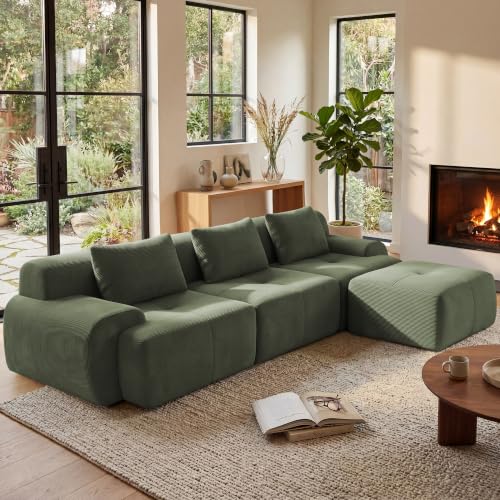
GRUSIGN 108'' Modular Boneless Sofa,Sectional Couch for Living Room | Tufted Oversized L Shape Deep Seat Sectional Sofa with Ottoman & 3 Throw Pillows,Corduroy Cloud Couch,Green
Check price on Amazon
Boneless Couch, Cloud Couch Sofa, Sectional Couches for Living Room | Comfy L-Shaped Modern Sectional Sofa, Upholstered Corduroy Couch with Storage Pocket for Apartment, No Assembly Required
Check price on Amazon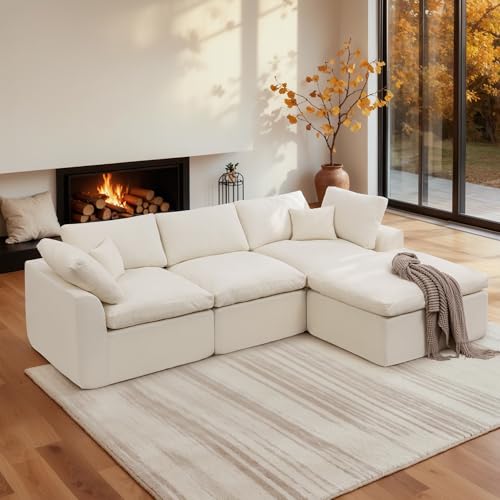
Korser 110" Cloud Sectional Couches for Living Room, Modern Modular Sectional Sofa with Ottoman, Boneless Cloud Couch with Comfy Deep Seats, Fluffy Chenille L-Shape Sofa Couch for Living Room, Beige
Check price on Amazon
Furmax Sectional Couches for Living Room, Chenille, Grey | U-Shaped Sofa Couch with Linen Fabric, 4 Seat Sofa Set with Double Chaise for Apartment
Check price on AmazonLayout Planning: Where the Sectional Should Go
Placement decides whether a sectional feels spacious or cramped. Three rules cover most rooms:
- Anchor to the longest wall or the room corner. The long segment backs onto the wall; the return extends toward the focal point.
- Face the focal point. Fireplace, TV, or view window — the seating should orient toward it without forcing necks to turn.
- Leave breathing room. Resist pushing the sectional flush into every corner. A few inches of gap at each end makes the room feel larger and protects upholstery from wall scuffs.
In coastal living rooms, a light-toned slipcovered sectional with a low back keeps sightlines open to the view. In open-plan homes, the back of the sectional can double as a room divider without a full partition. For a compact footprint, a sofa sized for small rooms or a sectional scaled for a small living room keeps the room functional without dominating it.
Pair the sectional with a sofa table for small spaces behind the backrest if you need a landing zone for drinks and lamps without blocking the walkway. Round or oval coffee tables soften the right angles of an L-shaped sectional; rectangular tables align with the long run.
Pre-Purchase Sectional Checklist
- Measure the wall run, return length, and all walkways — write the numbers down.
- Confirm door width, hallway turns, and stair clearance for delivery.
- Decide left-arm versus right-arm orientation based on the wall the sofa backs onto.
- Choose upholstery by household: pets and children favor performance fabrics or leather.
- Confirm whether cushion covers are removable and washable.
- For recliners, measure the wall clearance needed for full recline.
- Check the warranty and return policy, including return shipping terms — see sofa warranty and returns.
- Compare brands on equal terms using a brand comparison for sofas.
Common Sectional Buying Mistakes to Avoid
- Buying by silhouette alone. A sectional that looks right in a showroom may swallow a small room. Always check the return length against your floor plan.
- Ignoring recliner clearance. Power and push-back recliners need several inches behind the backrest. A wall-hugger recliner solves this in tight rooms.
- Choosing fixed orientation without a plan. If you rent or may rearrange, a modular sectional preserves your options.
- Skipping the entry-path test. Measure the delivery path before ordering, not after the truck arrives.
- Underestimating cushion maintenance. Down-wrapped cushions need regular fluffing; high-resilience foam needs less attention but feels firmer.
Frequently Asked Questions
What is the difference between a sofa sectional and a standard sofa?
A sofa sectional joins two or more seating segments at an angle, usually forming an L or U shape, while a standard sofa is a single straight unit. Sectionals seat more people in the same footprint and define a conversation zone, whereas standard sofas suit narrow walls and formal, symmetrical layouts.
How do I choose the right sectional configuration for my room?
Measure the longest wall and the distance to your focal point first. An L-shaped sectional with a chaise suits most medium rooms, a U-shaped or pit sectional fits large open-plan spaces, and a compact L-shaped or apartment sectional works in small rooms. Left-arm and right-arm orientation should follow the wall your sofa backs onto.
Are modular sectionals better than fixed sectionals?
Modular sectionals let you rearrange, extend, or split the seating to fit a new floor plan, which suits renters and open-plan homes. Fixed sectionals are typically more rigid in construction and simpler to assemble. If you plan to move or reconfigure the room, modular is the more adaptable choice.
What upholstery works best for a family sectional sofa?
Performance fabrics, tightly woven synthetics, and top-grain leather handle daily wear well. Look for removable, washable cushion covers and a high rub-count fabric for households with children or pets. Slipcovered sectionals offer the easiest long-term maintenance.
How much seating space should I leave around a sectional?
Leave at least 18 inches between the sectional and a coffee table, and roughly 30 to 36 inches for main walkways. The chaise or recliner extension needs clearance to fully open without blocking traffic. Confirm door widths and stair turns before delivery.
Ready to Compare Sectionals?
You now have the framework to evaluate any sofa sectional on configuration, construction tier, upholstery, and layout fit. Start with the recommended models above, shortlist two or three that match your measured space, and confirm the delivery path before ordering. If you are still deciding between a sectional and a reclining setup, the reclining sectional guide covers mechanism differences in detail.
For related planning topics, browse the sectional sofas category, the sofa and chair pairing guide, or the studio apartment sofa guide for compact layouts.