
Sleeper Sofa Sectional: The Complete Buyer's Guide
Discover how to choose a sleeper sofa sectional that delivers generous daytime seating and a comfortable overnight bed. From mattress types and frame construction to room measurements and configuration, this guide gives you everything you need to buy with confidence.
A sleeper sofa sectional solves a familiar problem: how do you furnish a living room that needs to seat a crowd by day and host overnight guests by night? The answer combines the expansive seating of a sectional with a hidden pull-out bed, letting one piece of furniture do the work of two. For households that entertain often, live in a space with limited guest rooms, or simply want maximum utility from a large furniture investment, a sleeper sectional is one of the most practical choices available.
This guide walks you through the decisions that matter most — the mechanism, the mattress, the frame, the fabric, and the footprint. By the end, you will understand exactly which configuration suits your room and how to evaluate quality before you commit.
What Is a Sleeper Sofa Sectional?
A sleeper sofa sectional is a multi-piece seating arrangement that incorporates a fold-out or pull-out bed beneath one of its seats or chaise sections. Unlike a standard sofa bed, which is typically a single two- or three-seat frame, a sectional sleeper spreads seating across an L-shaped or U-shaped footprint while concealing the sleeping mechanism in one segment. The result is a piece that anchors a living room, seats three to six people comfortably, and converts into a sleeping surface roughly the size of a full or queen mattress.
Most designs place the sleeper mechanism in the main straight section, while the chaise or corner piece remains fixed seating. Some modular models allow you to position the sleeper segment on either end, which is useful when you need the bed to open away from a wall or doorway.
Why Choose a Sleeper Sofa Sectional?
- Dual-purpose efficiency: One furniture piece serves as the everyday gathering spot and the guest bed, which is especially valuable in apartments, studios, and homes without a dedicated guest room.
- Generous seating: Sectionals seat more people than comparably sized standard sofas, and the chaise or corner provides a natural lounging spot.
- Room definition: An L-shaped sectional can visually divide an open-plan living and dining area without the need for walls.
- Long-term flexibility: Modular models let you reconfigure the layout as your space or needs change.
If you have pets or young children, look for models with removable, washable covers and tightly woven upholstery. Our guide to pet-friendly sectionals covers fabric and construction choices that hold up to daily wear. For a broader look at durable upholstery options, the pet-friendly sofa guide is a useful companion read.
Types of Sleeper Sectionals
Pull-Out Sleeper Sectionals
The most common design. A metal frame folds out from beneath the seat, and the mattress unfolds on top of it. Pull-out models tend to offer the most supportive sleeping surface because the mattress rests on a rigid frame rather than on the floor. The trade-off is that they need clear floor space in front of the sofa when extended. If you want a dedicated model, see our overview of the sectional sleeper sofa with pull-out sleeper.
Sectionals with Recliner and Sleeper Functions
Some premium configurations combine power reclining seats with a sleeper section, giving you movie-night lounging and a guest bed in one footprint. These models are heavier and require access to power outlets, but they deliver the highest level of everyday comfort. Explore the sectional sofa with recliner and sleeper for an example of this hybrid approach.
Chaise Sleeper Sectionals
A chaise section provides a built-in lounging surface and often houses the sleeper mechanism. This layout works well in corner placements and small living rooms because the chaise doubles as a visual anchor. See the queen-size sleeper sofa with chaise lounge for a representative configuration.
Futon-Based Sectionals
Futon-style sectionals use a fold-flat mechanism rather than a pull-out frame. They are generally lighter and easier to move, though the sleeping surface tends to be firmer and thinner. They suit occasional guest use rather than nightly sleeping.
Mattress Types Explained
The mattress is the single biggest factor in how well your guests sleep. Sleeper sectional mattresses are thinner than standard mattresses — typically four to six inches — so the materials and construction matter more than the thickness alone.
| Mattress Type | Best For | Feel & Notes |
|---|---|---|
| Memory Foam | Guest rooms and frequent overnight use | Body-conforming support, low motion transfer; can feel warm in unventilated rooms |
| Gel-Infused Foam | Warm climates and sleepers who run hot | Cooler than standard memory foam while retaining contouring support |
| Innerspring | Traditional feel and easy repositioning | Bouncier surface; coil count and gauge determine durability |
| Air-Over-Coil | Adjustable firmness preferences | Combines an air chamber with coil support; heavier mechanism |
| High-Density Foam | Occasional use and lighter sleepers | Firmer, more basic construction; entry-level tier in most lineups |
If the original mattress wears out, replacement is straightforward on most models. Our guides to a queen-size sleeper sofa mattress replacement and a replacement mattress for a sofa bed explain how to measure and choose a compatible option. For thicker, more hotel-like comfort, consider a queen-size sleeper sofa with thick mattress.
Frame and Mechanism Quality
The frame and folding mechanism determine how long the sleeper function lasts. Look for these indicators of durable construction:
- Hardwood or engineered hardwood frames: Kiln-dried hardwood resists warping and holds screws tightly over years of use.
- Heavy-duty steel mechanism: The folding frame should be reinforced at the joints and rated for repeated open-and-close cycles.
- Smooth operation: A quality mechanism glides without binding, and the locking latches engage firmly.
- Weight capacity: Check the manufacturer's rated capacity for the sleeping surface, not just the seating surface.
Entry-level models often use lighter particleboard and thinner gauge steel, while mid-range and premium tiers typically move to hardwood and reinforced mechanisms. If long-term durability is your priority, focus on models described as professional-grade or commercial-grade, which are built for higher-frequency use.
Sizing and Room Measurement
A sleeper sectional occupies more floor space than a standard sofa, and it needs additional clearance when the bed is extended. Measure carefully before you choose a configuration.
Step-by-Step Measurement
- Measure the length of the wall where the main section will sit.
- Measure the depth of the chaise or corner return and confirm it does not block a walkway.
- Add the extension depth of the pull-out bed (typically 60–80 inches) and confirm the open bed clears furniture, doorways, and traffic paths.
- Leave at least 30 inches of walking clearance around the seating area.
- Check door widths and hallway turns if the sectional must be delivered through a narrow entry. Models designed to fit through tight spaces are covered in the sofa that can fit through narrow doors guide.
For compact rooms, a queen-size sleeper sofa for small spaces or a small sectional sofa with chaise may be the better fit. If you are furnishing a studio, the small sofa for studio apartment guide offers additional layout strategies.
Choosing a Configuration
Sleeper sectionals come in several layouts. Match the configuration to the shape of your room and the way you use the space.
| Configuration | Best For | Considerations |
|---|---|---|
| L-Shaped with Chaise | Corner placements and open-plan rooms | Defines the seating zone; chaise adds lounging space |
| U-Shaped | Large family rooms and entertaining spaces | Maximum seating; requires a generous footprint |
| Modular | Flexible layouts and future reconfiguration | Individual pieces can be rearranged; check connector hardware |
| With Recliner | Everyday comfort and media rooms | Heavier; needs power access for power-reclining models |
| With Storage | Small rooms and households needing extra organization | Storage compartments reduce usable seating depth in some designs |
If organization is a priority, a sectional sofa with chaise and storage keeps throws, pillows, and bedding tucked away. For rooms where versatility matters most, compare the sectional sofa with chaise and recliner against a pure sleeper layout.
Fabric and Material Guide
Upholstery choice affects durability, maintenance, and the room's overall look. Consider these common options:
- Performance fabric: Woven synthetics treated for stain and moisture resistance; the most practical choice for families and pets.
- Microfiber: Soft, dense, and easy to spot-clean; a solid mid-range option.
- Woven linen blends: Breathable and textured, with a relaxed look; check cleanability codes.
- Leather and faux leather: Wipe-clean and long-wearing; genuine leather develops a patina over time.
- Velvet: Rich appearance and soft hand; better suited to low-traffic rooms.
Removable, washable covers extend the life of any sleeper sectional. If you prefer a changeable look, a slip-covered sofa approach lets you refresh the upholstery without replacing the frame. Our slipcovered furniture overview explains how covers interact with sleeper mechanisms.
Pre-Purchase Checklist
- Measure the wall space, room depth, and pull-out clearance.
- Confirm the sleeping surface size (full vs. queen) matches your guest needs.
- Test the mechanism in person if possible, or read reviews about long-term durability.
- Verify the mattress type, thickness, and replacement availability.
- Check the frame material and weight rating for both seating and sleeping.
- Review the warranty terms for the frame, mechanism, and mattress separately.
- Confirm delivery requirements, including door widths and stair access.
Editor's tip: Ask whether the sleeper mechanism is serviceable and whether replacement parts are stocked. A mechanism that cannot be repaired shortens the usable life of the entire sectional.
Recommended Sleeper Sofa Sectionals
⚠️ AFFILIATE DISCLOSURE: This website contains affiliate links. As an affiliate Associate, we earn from qualifying purchases. If you make a purchase through these links, we may receive a small commission at no additional cost to you. Read our full affiliate policy.

Marsail 110" Modular Sectional Sleeper Sofa, Pull Out Sofa Bed with Storage | 7 Seat Comfy Cloud Sofas for Living Room, Chenille Sectional Couches with USB Ports & Cup Holders, Dark Gray
Check price on Amazon
108'' Modular Sectional Sleeper Sofa Couches for Living Room, Dark Grey | L/U Shaped Sleeper Sofa, Pull Out Couch Bed, Hidden Storage, Modular Design, Comfy Corduroy, Removable Cover, Movable Ottoman
Check price on Amazon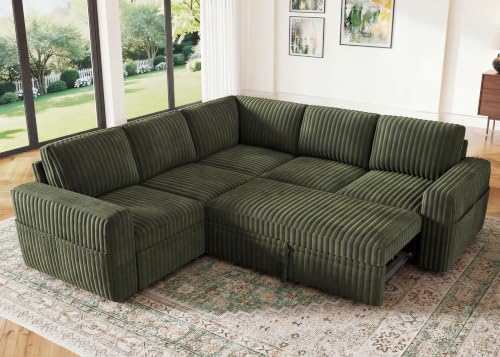
HONBAY Corduroy L Shaped Sectional Sleeper Sofa with Pull Out Bed,Green | modular design,built-In storage, couches for living room and apartment guest sleeping space,removable cushions
Check price on Amazon
WUNSTANTE Sectional Sleeper Sofa with Pull Out Bed, Plush Corduroy 7 Seat Modular Sectional Sofa with Storage Chaise and Adjustable Backrest, Cloud Couches for Living Room, Apartment, Dark Grey
Check price on Amazon
WUNSTANTE Sectional Sleeper Sofa with Pull Out Bed, Plush Corduroy 5 Seat Modular Sectional Sofa with Storage Chaise and Adjustable Backrest, Cloud Couches for Living Room, Apartment, Dark Grey
Check price on Amazon
108'' Sectional Couches for Living Room, Sectional Sleeper, Black | L/U Shaped Sleeper Sofa, Pull Out Couch Bed, Hidden Storage, Modular Design, Comfy Corduroy, Removable Cover, Movable Ottoman
Check price on Amazon
Ihanherry 86" Modular Sectional Sofa with Pull Out Bed, 4-Seater L Shaped Sectional Sleeper Couch with Storage Ottoman, Chenille Convertible Couches for Living Room, Apartment (Green)
Check price on AmazonFrequently Asked Questions
Is a sleeper sofa sectional comfortable for nightly sleeping?
It can be, provided the mattress is a quality memory foam or gel-infused model and the mechanism rests on a rigid frame. Entry-level foam mattresses are better suited to occasional guest use, while mid-range and premium sleeper sectionals are designed for more frequent sleeping.
How much floor space does a pull-out sectional need?
Most pull-out beds extend 60 to 80 inches in front of the sofa. Measure that clearance plus at least 30 inches of walking room, and confirm the extended bed does not block doorways or heating vents.
Can I replace the mattress in a sleeper sectional?
Yes, in most cases. Replacement mattresses are available in standard sleeper sizes. Measure the folded mattress compartment and match the thickness and dimensions before ordering.
What is the difference between a pull-out sleeper and a futon sectional?
A pull-out sleeper uses a folding metal frame that extends the mattress outward, keeping the sleeping surface elevated. A futon sectional folds flat in place. Pull-out designs generally provide more support, while futons are lighter and simpler to operate.
How do I keep a sleeper sectional looking good in a high-traffic room?
Choose performance fabric or leather, vacuum regularly, rotate and fluff cushions, and use removable covers where possible. For households with pets, review the pet-friendly sofa guide for fabric and construction recommendations.
Ready to Compare Sleeper Sofa Sectionals?
Browse the recommended models above, then review the specifications that matter most: mattress type, mechanism quality, frame material, and footprint.
Explore Top Picks