
Zero Wall Clearance Reclining Sofa: The Complete Buying Guide
Maximize comfort without wasting floor space. Learn how wall-hugger recliners work, what to check before buying, and how to place one in a small or open living room.
Explore Recommended ModelsWhy this guide matters: If you are researching a reclining sofa, you already know the comfort you want. The missing piece is usually space. A zero wall clearance reclining sofa solves that problem by sliding forward instead of backward, letting you place it close to a wall, window, or room divider. This guide explains the mechanism, the trade-offs, and the features that separate a solid model from a compromised one, so you can buy with confidence.
What Is a Zero Wall Clearance Reclining Sofa?
A zero wall clearance reclining sofa, also called a wall-hugger or zero-wall recliner, is a reclining seat engineered so the backrest pivots and the seat slides forward as it reclines. Traditional recliners need a foot or more of open space behind them because the backrest tilts backward. A wall-hugger avoids that by moving the whole seating surface forward on its track.
The practical result: you can push the sofa close to a wall and still recline fully. This is especially useful in apartments, narrow living rooms, and open-concept spaces where the sofa backs onto a traffic path or a kitchen island. If you are weighing this against a conventional model, our guide to zero clearance recliners explains the mechanical differences in more detail.
Wall-hugger sofas come in manual and power versions, in two-seat and three-seat layouts, and in leather, faux leather, and fabric covers. Many models also include a center console with cup holders, USB ports, or storage. The core idea stays the same: comfort without the rear clearance penalty.
How the Wall-Hugger Mechanism Works
The key component is a sliding track or a pivoting linkage that changes the geometry of the recline. When you pull the lever or press the power button, the seat base travels forward while the backrest angles back. The wall behind the sofa remains untouched because the backrest does not swing past the frame's rear plane.
- Manual wall-hugger: a lever or paddle releases a spring-assisted mechanism. Fewer electronics, fewer failure points, and a lighter frame.
- Power wall-hugger: a motor drives the recline, usually with a wired remote or a side-mounted button. Smoother motion and easier for people with limited mobility.
- Forward-sliding track: the most common design. The seat moves forward on rails, so the sofa needs a few inches of front clearance for the footrest.
- Pivot-linkage design: the backrest rotates on a linkage that keeps the rear profile fixed. These often need even less rear clearance.
Because the seat travels forward, plan for the footrest extension in front of the sofa. A typical reclined footrest adds roughly 20 to 30 inches of forward projection, depending on the model. That forward space is the real constraint in a small room, not the wall behind the sofa.
Key Features to Compare Before You Buy
Wall-hugger sofas vary widely in build and comfort. Use this checklist to compare models on the features that matter most.
| Feature | Why It Matters | What to Look For |
|---|---|---|
| Rear clearance | Determines how close the sofa can sit to a wall | Two to six inches is typical; check the manufacturer's stated minimum |
| Recline mechanism | Affects smoothness, durability, and ease of use | Manual for simplicity, power for accessibility; look for reinforced linkage |
| Frame material | Supports the sliding mechanism and long-term stability | Hardwood or high-grade steel frames outperform particle board |
| Upholstery | Affects cleaning, durability, and feel | Leather for wipe-clean ease; performance fabric for family homes |
| Seat cushioning | Comfort during long sitting sessions | High-density foam or pocket coils; avoid soft foam that bottoms out |
| Console features | Adds utility in a living room setting | Cup holders, USB charging, hidden storage |
| Weight capacity | Safety and longevity of the mechanism | Check the per-seat rating; heavy-duty mechanisms suit larger users |
When comparing tiers, an entry-level wall-hugger often uses a lighter frame and basic foam, while a mid-range model typically adds a smoother mechanism and better cushion density. Premium and luxury tiers focus on full-grain leather, reinforced steel linkage, and quieter power motors. The differences show up in long-term durability and recline smoothness rather than in the basic function.
Recommended Zero Wall Clearance Reclining Sofas
⚠️ AFFILIATE DISCLOSURE: This website contains affiliate links. As an affiliate Associate, we earn from qualifying purchases. If you make a purchase through these links, we may receive a small commission at no additional cost to you. Read our full affiliate policy.

HOHYLUX Zero Wall Hugger Power Reclining Sofa with Adjustable Headrest | Electric Reclining Couch RV Loveseat Recliner Sofa with Charge Device &Drop Down Table
Check price on Amazon
Marsail 95" 3-Seater Power Reclining Sofa with Zero Gravity, Gray | Zero Wall Hugger Design for Living Room, Pet-friendly Tri-Proof Fabric, USB A & C Charge Ports, Adjustable Headrest
Check price on Amazon
POVISON Ergopals 84'' Reclining Sofa, Loveseat Recliner, 2 Seater, Beige | Wall Hugger, Zero Gravity, Waterproof, Pet-Friendly, Power Headrest, Charging Ports, Recliner Loveseat for RV, Living Room
Check price on Amazon
KISLOT Zero Wall Hugger Loveseat Recliner Sofa with Center Console, Gray | Reclining Sofa with USB Charging, Cup Holders for Living Room, Bedroom, Office, RV, Faux Leather
Check price on Amazon
MisUMis Power RV Loveseat Recliner Sofa, Electric Reclining Loveseat RV Couch with USB & Type-C Ports, Zero Wall Hugger RV Furniture with Storage & LED Light for Travel Trailers Home Theater Seating
Check price on Amazon
HOHYLUX Zero Wall Hugger Power Reclining Sofa with Adjustable Headrest | Electric Reclining Couch RV Loveseat Recliner Sofa with Charge Device &Drop Down Table
Check price on Amazon
Dresegmt Power Loveseat Recliner Sofa, Zero Wall Hugger RV Reclining Loveseat Couch with Flip Middle Backrest Design, 3 Seat Reclining Sofa with Storage Drawer, Power Recliner for Living Room (Brown)
Check price on Amazon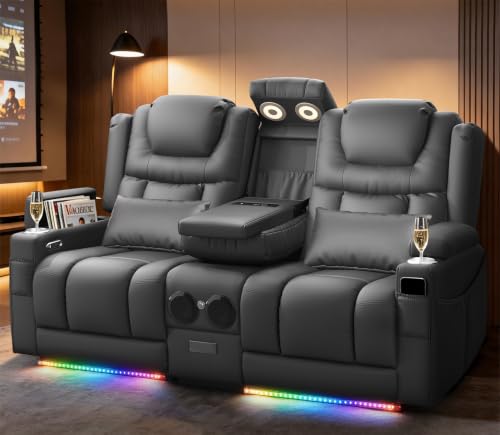
DG PEAFOWL Power Loveseat Recliner Sofa with Console, Wall Hugger Reclining Loveseat with Reading Light, Home Theater Seating with LED Lights, Zero Gravity Recliner Couch for RV Couch and Living Room
Check price on AmazonHow to Place a Wall-Hugger in Your Living Room
Placement decides whether a wall-hugger actually delivers its space-saving benefit. Measure both the rear clearance and the forward projection before you commit.
- Measure the wall span. Confirm the sofa width plus a few inches of breathing room on each side. A tight wall can make a wide sofa feel cramped even if it fits.
- Check the rear gap. Read the manufacturer's minimum wall clearance. Leave a small gap for cords and skirting boards, and avoid pressing the sofa hard against a radiator or heating vent.
- Plan the forward travel. Mark the fully reclined footrest position on the floor with tape. Ensure walkways, coffee tables, and door swings stay clear.
- Mind the power source. Power recliners need an outlet nearby. Route cords along the wall or under a rug to avoid trip hazards.
- Protect hard floors. The forward slide can scuff wood or laminate. Felt pads or a protective mat under the feet help.
For rooms where the sofa backs onto a walkway rather than a wall, a wall-hugger still helps because the backrest stays within the frame footprint. Pair it with a slim C-shaped end table to keep drinks and remotes within reach without blocking the recline path.
If the room is genuinely small, compare this option with a zero wall hugger recliner for small spaces or a compact zero wall reclining sofa layout. Both prioritize the same forward-slide principle in a tighter footprint.
Comfort, Durability, and Long-Term Ownership
A wall-hugger only earns its place if it stays comfortable and functional for years. Focus on three areas: the mechanism, the cushion core, and the cover.
The mechanism. Ask whether the linkage is reinforced and whether the track is metal rather than plastic. A heavy-duty mechanism with a solid build handles daily use better than a lightweight one. Power models should have a manual override in case the motor fails.
The cushion core. High-density foam and pocket-coil seating resist flattening. Sit in the sofa for at least ten minutes if you can, and check whether the seat edge supports your thighs without a hard bar pressing through.
The cover. Leather and faux leather wipe clean easily, which suits households with pets or young children. Performance fabrics resist stains and are often removable. For a family room, a performance fabric wall-hugger is often the more practical long-term investment than a delicate fabric.
Also confirm the warranty covers the reclining mechanism separately from the frame and cover. Mechanism warranties are the most useful protection on a wall-hugger because that is the part doing the most work.
Common Mistakes to Avoid
- Ignoring forward projection. Buyers focus on rear clearance and forget the footrest needs room in front. Measure both.
- Assuming all wall-huggers are identical. Rear clearance ranges from near-flush to several inches. Check the spec sheet, not the marketing label.
- Overlooking the outlet. A power recliner without a nearby outlet leads to extension cords across the floor.
- Skipping the weight rating. A mechanism rated below the user's weight wears out faster and can fail.
- Choosing cover material by look alone. A beautiful fabric that stains easily becomes a daily frustration in a family living room.
Frequently Asked Questions
How much wall clearance does a zero wall reclining sofa need?
Most models need only two to six inches behind the sofa, compared with twelve to eighteen inches for a traditional recliner. Some pivot-linkage designs can sit almost flush against the wall. Always check the manufacturer's stated minimum, because the figure varies by mechanism.
Are zero wall reclining sofas as comfortable as standard recliners?
Yes. The wall-hugger mechanism changes how the backrest pivots, not the seat depth or cushioning. A well-built wall-hugger offers the same recline angle and lumbar support as a conventional recliner. Comfort differences come from cushion quality and frame build, not from the wall-hugger design itself.
Can a zero wall recliner be placed on hardwood floors?
Yes, but the seat slides forward during recline, so protect the floor with felt pads or a mat under the feet. Also confirm the sofa's weight rating and foot design are suitable for hard flooring, and keep the track area free of grit that could scratch the finish.
Do zero wall reclining sofas require assembly?
Most ship in two or three sections. You typically attach the backrests, legs, and console, then connect the power leads if it is a power model. Assembly is usually straightforward, but check whether white-glove delivery is available if you prefer professional setup.
Is a manual or power wall-hugger better?
Manual models are simpler, lighter, and have fewer electronic parts to fail. Power models are smoother and easier for people with limited mobility. If you choose power, confirm there is a manual override and a nearby outlet. For most households, either works well when the mechanism is well built.
Ready to Choose Your Wall-Hugger?
A zero wall clearance reclining sofa is the practical answer when you want full recline without surrendering floor space. Focus on rear clearance, forward projection, mechanism quality, and cover durability, and you will end up with a sofa that fits your room and your daily routine.
Compare the recommended models above, check the specifications against your measurements, and confirm the warranty covers the reclining mechanism. With those boxes ticked, you can move from research to a confident purchase.
View Recommended Models