
Three Seater Sofa with Two Recliners: The Complete Buying Guide
A three seater sofa with two recliners delivers the ideal balance of shared seating and individual comfort. Two people can fully recline while a third remains comfortably upright. This guide walks you through every decision point — from reclining mechanism types and frame construction to fabric durability and room sizing — so you can choose with confidence and enjoy your sofa for years.
Who this guide is for: Buyers who already know they want dual reclining functionality and need clear, practical information to finalize their decision. Whether you are outfitting a family room, a home theater, or a living space where comfort is the priority, the details below will help you compare models intelligently.
Why a Three Seater Sofa with Two Recliners Makes Sense
A standard three seater gives you three seats but often only average comfort. A three seater sofa with two recliners upgrades two of those seats into full lounge positions — footrests extend, backrests tilt, and the experience shifts from "sitting" to "relaxing." The third seat stays fixed, which suits guests who prefer an upright posture, children, or anyone who simply wants to read or converse while others recline.
This configuration is particularly popular in living rooms that host both everyday family time and occasional guests. It also works well in media rooms and open-plan spaces where the sofa doubles as the primary entertainment anchor. Compared with a double reclining sofa that offers only two total seats, the three-seater version adds capacity without sacrificing recline functionality.
One practical advantage worth noting: the fixed center seat provides a stable, always-upright position for activities that do not pair well with a tilted backrest — eating, working on a laptop, or supervising young children. That flexibility is why the dual-recliner three-seater has become one of the most requested configurations in family homes.
Manual vs. Power Reclining Mechanisms
The reclining mechanism is the heart of this sofa type. Two broad categories dominate the market, and each carries distinct trade-offs.
Manual Recliners
Manual mechanisms operate through a lever on the side of the seat or a push-back motion on the backrest. Entry-level and mid-range models most often use lever-based systems, while push-back designs appear on simpler pieces. Manual recliners are mechanically straightforward, have fewer electronic components to fail, and generally require less maintenance over time. The reclining motion is controlled entirely by body weight and lever input, which some users find intuitive and others find less precise than motorized adjustment.
If you prefer a proven mechanical design and want to avoid dependence on electrical outlets, a sectional with a manual recliner or a manual three-seater is a reliable direction. Manual sofas also tend to weigh less than their power counterparts, which matters if you occasionally rearrange the room.
Power Recliners
Power recliners use electric motors controlled by buttons or switches, allowing smooth, incremental adjustment of the backrest and footrest. Premium and luxury tiers frequently add USB charging ports, power headrests, and lumbar support adjustment. A power rocker recliner with an adjustable headrest illustrates how far the category has evolved — headrest angle and recline depth can be fine-tuned independently.
The main considerations with power mechanisms are the need for nearby power outlets and the presence of electronic components that, while generally durable, introduce a failure point that manual systems do not have. Mid-tier and high-end tier power sofas typically use reinforced motors rated for thousands of cycles, so longevity is rarely a concern when you buy from a reputable manufacturer.
| Aspect | Manual Recliner | Power Recliner |
|---|---|---|
| Adjustment control | Lever or push-back | Button or switch, incremental |
| Electrical requirement | None | Requires outlet access |
| Typical tier | Entry-level to mid-range | Mid-range to luxury |
| Extra features | Minimal | USB ports, power headrest, lumbar |
| Maintenance profile | Simple mechanical upkeep | Motor and wiring checks |
| Best for | Straightforward comfort, no outlet nearby | Fine-tuned comfort, tech-friendly rooms |
Sizing and Room Fit: What to Measure Before You Buy
Reclining sofas occupy more floor space than fixed sofas because the footrests extend forward and the backrests tilt backward. A three seater with two recliners typically needs roughly 8 to 12 inches of clearance behind the sofa (for wall-hugger or zero-wall models, less) and enough open floor in front for the extended footrests.
Key measurements to take
- Wall-to-front clearance: Measure from the wall to the furthest point you want the footrests to reach. Fully reclined, many models extend 60 to 70 inches from the back of the sofa.
- Seat width per person: Divide the total seating width by three. Comfortable seats are typically 20 to 24 inches wide; narrower seats suit smaller users or children.
- Doorway and hallway width: Confirm the sofa can physically enter your home. Some reclining sofas ship in sections or with removable backs.
- Outlet placement: For power models, verify an outlet is reachable without an extension cord running across walkways.
If your room is tight, consider three seater sofas designed for small spaces, which often use slimmer arms and wall-hugger mechanisms. For larger rooms, an extra-wide recliner paired with a standard seat can create a more generous seating arrangement. And if the room must also serve as a guest space, a three seater sofa with a pull-out bed adds overnight capacity — though note that combining recline and sleeper functions in one piece usually means accepting a bulkier frame.
Upholstery and Frame Materials
Durability in a reclining sofa comes from two places: the frame and the upholstery. Both deserve scrutiny.
Frame construction
Look for hardwood or engineered hardwood frames with reinforced joints at the reclining mechanism mounting points. Heavy-duty recliners use high-grade steel in the mechanism itself, and heavy-duty recliner mechanisms are rated for higher weight capacities and more cycles. A solid build with corner-blocked joints is the single best indicator of long-term structural integrity.
Upholstery options
- Leather and faux leather: Easy to wipe clean, resistant to spills, and well-suited to households with children. Full-grain and top-grain leather are premium tiers; bonded leather and faux leather sit at entry-level and mid-range.
- Fabric and microfiber: Softer hand-feel and broader color selection. Performance fabrics resist stains and are a strong mid-tier choice. A fabric reclining sofa and loveseat set shows how fabric can match leather's practicality when the weave is tightly constructed.
- Velvet: A luxury-tier aesthetic with a plush surface. Velvet requires more careful maintenance but delivers a distinctly upscale look.
For pet owners, tightly woven performance fabric or leather is the safer bet. For households focused on easy cleaning, leather and faux leather remain the most forgiving. If you are comparing a leather sofa against fabric alternatives across a full room, the same material logic applies to coordinating pieces.
Comfort, Cushioning, and Support
Reclining comfort depends on more than the mechanism. Cushion fill and back support determine how the sofa feels after an hour, not just after five minutes.
Cushion fill types
- High-density foam: The most common fill. Firm, supportive, and durable. Mid-range and premium sofas typically use higher-density foam that resists sagging.
- Foam-wrapped pocket coils: Adds springiness and airflow. Common in high-end tier recliners.
- Down and down-blend: Luxurious softness with a "sink-in" feel. Requires regular fluffing and suits buyers who prioritize plushness over firmness. A down-filled sofa is the reference point for this comfort profile.
If you prefer a sofa that holds its shape and supports long sitting sessions, high-density foam is the dependable choice. If you want maximum softness, down blends deliver — at the cost of more maintenance. Buyers who find most sofas too soft should look specifically at firmer builds; resources on the firmest sofa options explain what to look for in support structure.
Back and lumbar support
Reclined seating shifts pressure to the lower back. Models with built-in lumbar support or adjustable lumbar mechanisms reduce strain during long sessions. Power headrests add neck support when the backrest is tilted far back. These features are most common in premium and luxury tiers but are increasingly available in mid-range models.
Features Worth Prioritizing
Beyond the core recline function, several features meaningfully improve day-to-day use:
- Wall-hugger / zero-wall mechanism: Allows the sofa to sit close to the wall while still reclining fully. Essential for small rooms.
- USB charging ports: Convenient for phones and tablets; common on power models.
- Cup holders and consoles: A center console with cup holders converts the middle seat into a shared armrest with storage. An L-shape sofa with a recliner and cup holder demonstrates how these add-ons integrate into larger configurations.
- Adjustable headrest and lumbar: The most impactful comfort upgrade for tall or short users alike.
- Removable backs: Simplifies delivery through tight doorways and stairwells.
Not every feature is necessary. Cup holders and USB ports are nice-to-haves; mechanism quality and frame construction are must-haves. Spend your attention budget accordingly.
Final Buying Checklist
Before you commit, run through this list:
- Measure wall clearance and confirm the recline footprint fits your room.
- Decide between manual and power based on outlet access and desired control.
- Confirm the frame material and mechanism rating (weight capacity, cycle rating).
- Choose upholstery that matches your household — pets, kids, and cleaning habits.
- Test the cushion firmness in person if possible, or read detailed comfort reviews.
- Verify delivery access: doorway width, stair turns, and whether backs are removable.
- Check the warranty coverage for the mechanism specifically, not just the frame.
If you are also furnishing the rest of the room, coordinating pieces such as a two seater sofa or a loveseat sofa bed can complete the seating arrangement without duplicating the recliner function.
Recommended Three Seater Sofas with Two Recliners
⚠️ AFFILIATE DISCLOSURE: This website contains affiliate links. As an affiliate Associate, we earn from qualifying purchases. If you make a purchase through these links, we may receive a small commission at no additional cost to you. Read our full affiliate policy.

HAOMARKETS 3 Pieces Recliner Sofa Furniture Set, Include 2 Power Recliner Chairs with Message&Heat and a 3-Seater Reclining Couch for Living Room, Brown
Check price on Amazon
LINSY Modular 3+2 Seater Recliner Sofa Set, Manual Corduroy Living Room Sectional with Flip-Down Console, Cup Holders, USB Ports & Hidden Storage, Theater Couch for Living Room, Game Room (Green)
Check price on Amazon
ANJ 3-Piece Faux Leather Power Recliner Sofa Set with USB&Type-C Charging Ports, 2 Single Large Recliner Chairs and 3-Seater Reclining Couch for Living Room, Brown
Check price on Amazon
HAOMARKETS 3-Piece Manual Recliner Sofa Set, Included 2 Recliner Chair and 3-Seater Couch with Padded Backrest, Overstuffed Fabric Reclining Couches with Cup Holders for Living Room, Green
Check price on Amazon
EBELLO Power Reclining Sofa Set, 2 Fabric Electric Recliner Chair and 3 Seater Sofa Couch with Cup Holders, USB Type-C Charging Ports, 5 Seats for Small Living Room, and Meeting Room, Grey
Check price on Amazon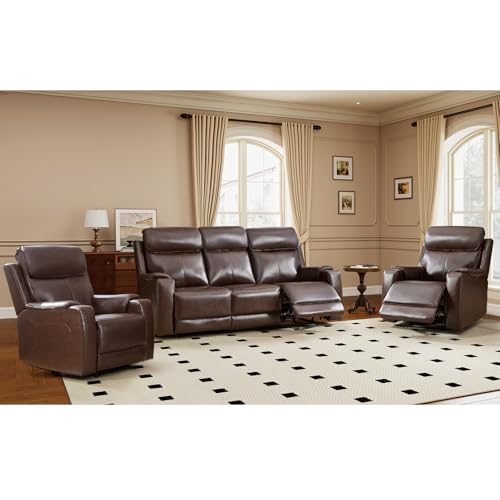
HAOMARKETS 3-Piece Top Grain Leather Power Reclining Sofa Set, Include 2 Dual Motor Electric Recliner Chair with Adjustable Headrest and 3-Seater Couches for Living Room, Dark Brown
Check price on Amazon
EBELLO Reclining Couch, 3 Seater Recliner Sofa for Living Room, 2 Cup Holders and Side Pocket, Manual Recliner Couch Theater Seating for Home Office, Light Grey
Check price on Amazon
Sofetura Oversized Loveseat Recliner Sofa with Cup Holders & Side Pockets, Big Large Reclining Sofa, Traditional 2-Seater Manual Recliner Couch for Living Room, RV, Home Theater (Fabric,Grey)
Check price on AmazonFrequently Asked Questions
Can two people recline at the same time on a three seater with two recliners?
Yes. The defining feature of this configuration is that both outer seats recline independently, so two occupants can adjust their positions simultaneously. The center seat remains fixed.
How much space do I need behind the sofa?
Traditional recliners need roughly 8 to 12 inches of clearance behind the backrest. Wall-hugger and zero-wall mechanisms reduce this to as little as 2 to 4 inches, making them suitable for tighter rooms.
Is a power recliner worth it over manual?
Power recliners offer smoother, more precise adjustment and often include USB charging and adjustable headrests. Manual recliners are mechanically simpler and do not require an outlet. The right choice depends on your priorities: convenience and features versus simplicity and placement flexibility.
What weight capacity should I look for?
Standard reclining sofas typically support around 250 to 300 pounds per seat. Heavy-duty models with reinforced steel mechanisms support higher capacities. Check the manufacturer's per-seat rating rather than a single total figure.
Can I place a reclining sofa against the wall?
Only if it uses a wall-hugger or zero-wall mechanism. Standard recliners require clearance for the backrest to tilt. Always confirm the mechanism type before placing the sofa flush against a wall.
How do I clean a reclining sofa?
Leather and faux leather wipe clean with a damp cloth and mild soap. Fabric models benefit from regular vacuuming and spot cleaning with upholstery-safe products. Avoid saturating cushions, and check the manufacturer's cleaning code before using any solution.