
Sectional Sofa With Manual Recliner: The Complete Buyer's Guide
Everything you need to understand manual reclining sectionals — how the mechanism works, which layouts suit your space, which upholstery holds up, and how to choose with confidence before you commit.
EXPLORE RECOMMENDED MODELSWhy this guide matters: If you are researching a sectional sofa with a manual recliner, you likely already know you want reclining comfort across a larger seating area. What you probably still need is clarity on mechanism types, clearance requirements, upholstery durability, and configuration choices. This guide walks through each decision point so you can buy with confidence.
What Is a Sectional Sofa With Manual Recliner?
A sectional sofa with manual recliner combines two popular furniture concepts: the multi-seat configuration of a sectional and the adjustable comfort of a reclining seat. Unlike a power recliner that relies on an electric motor and hand control, a manual recliner uses a lever or pull handle connected to a spring-assisted mechanical system. When you pull the handle, the footrest extends and the backrest tilts, letting you shift from upright seating to a relaxed lounging position.
These sectionals typically include one or more reclining seats within an L-shaped or U-shaped layout. Common configurations include a reclining seat at one end, a reclining seat plus a console with cup holders, or a row of two to three reclining seats along the main sofa section. The rest of the sectional remains fixed, providing standard seating for guests, family members, or everyday use.
The appeal is straightforward: you get the room-filling seating capacity of a sectional with the personalized comfort of a recliner, and you avoid the electronic components that power recliners require. For many households, that combination is a practical long-term fit.
How the Manual Recliner Mechanism Works
Understanding the mechanics helps you evaluate quality and set realistic expectations. A manual recliner mechanism consists of a few core parts: a lever or pull handle, a spring-loaded latch, a metal frame with pivot points, and a footrest assembly. When you pull the lever, the latch releases and the spring tension, combined with your body weight, pushes the footrest forward and reclines the backrest. To return to the upright position, you push down on the footrest with your legs until it clicks back into the locked position.
Manual mechanisms are generally simpler than power mechanisms. There is no motor, no wiring, and no remote control to fail. That simplicity is a genuine advantage for long-term ownership. The trade-off is that you control the motion with your body rather than a button, which some users find less smooth than a power recliner. A well-built manual mechanism, however, can feel reassuringly solid and operate reliably for many years.
Manual vs. Power Recliner: A Quick Comparison
| Feature | Manual Recliner | Power Recliner |
|---|---|---|
| Operation | Lever or pull handle; body weight assists motion | Electric motor controlled by button or remote |
| Components | Springs, latch, metal frame, lever | Motor, wiring, control panel, transformer |
| Repair complexity | Lower; fewer parts to fail | Higher; electronics and motor may need service |
| Motion feel | Firm, mechanical, weight-assisted | Smooth, gradual, button-controlled |
| Wall clearance | Standard models need several inches behind | Wall-hugger options available; varies by model |
| Best for | Households prioritizing simplicity and durability | Users wanting effortless adjustment and extra features |
Neither option is universally better. The right choice depends on who will use the sofa most, how often the recliner will be adjusted, and whether you prefer mechanical simplicity or powered convenience. If you want to explore powered alternatives, you can review options like a power rock recliner or a power sofa with adjustable lumbar support to compare how they feel in practice.
Popular Layouts for Manual Reclining Sectionals
Layout is one of the most consequential decisions. The configuration determines how many people can sit comfortably, how the recliner integrates with the rest of the seating, and how the sofa fits into your room. Here are the most common arrangements:
- L-shaped sectional with one recliner: The recliner sits at one end, and the chaise or extended section provides lounging space for a second person. This is a versatile choice for medium-sized living rooms.
- L-shaped sectional with two recliners: Two reclining seats, often separated by a console or armrest, give couples or family members their own adjustable seat. This layout works well in family rooms.
- U-shaped sectional with recliners: A larger footprint with reclining seats along one side and fixed seating on the other. This arrangement suits open-plan spaces and households that entertain frequently.
- Reclining sectional with chaise: Combines a recliner with a chaise lounge section, offering both adjustable comfort and a dedicated lounging spot. You can explore similar configurations in the leather sectional with chaise and recliner category.
- Compact two-piece sectional: A smaller L-shape with a single recliner, designed for apartments or rooms with limited floor space. A sectional sofa with movable chaise can add flexibility if you occasionally rearrange the room.
When evaluating layout, consider traffic flow, the position of the TV or focal point, and whether the reclining seats should face the focal point directly. A recliner that faces a wall or a walkway is far less useful than one oriented toward the room's primary viewing area.
Space and Clearance: What to Measure Before You Buy
Manual recliners require clearance to operate. A standard manual recliner needs space behind the backrest to tilt backward, and space in front for the footrest to extend. Depending on the model, that can mean anywhere from a few inches to over a foot of clearance behind the sofa. Wall-hugger or zero-wall mechanisms reduce the rear clearance by sliding the seat forward instead of tilting the backrest, but they still need some room to operate.
Before ordering, measure three things: the available floor length and depth for the sectional, the clearance behind the reclining seat, and the width of doorways and hallways along the delivery path. A sectional that fits the room but cannot pass through the entryway is a common and avoidable problem. If your space is tight, a sofa less than 80 inches long or a compact sectional configuration may be a better fit than a full-size U-shaped model.
Measurement checklist
Confirm the sectional's overall dimensions, the recline clearance behind each reclining seat, the footrest extension depth, the seat height and depth, and the delivery path width. Also check whether the sectional can be separated into pieces for easier transport, and whether the reclining section can be positioned at either end during assembly.
Upholstery Choices That Hold Up Over Time
The upholstery determines how the sectional looks, how it feels, and how well it survives daily use. For a manual reclining sectional, pay particular attention to the areas that experience the most friction: the seat cushions, the backrest, and the footrest surface. Here are the most common options and their practical characteristics:
- Top-grain leather: Durable, easy to wipe clean, and develops a patina over time. It resists everyday spills and pet hair better than most fabrics. A top-grain leather manual reclining sofa is a strong long-term choice for households that want low-maintenance care.
- Performance fabric: Engineered to resist stains, moisture, and fading. It is a practical option for families with children or pets. A performance fabric sectional balances softness with resilience.
- Microfiber: Tightly woven and soft to the touch, with good resistance to everyday wear. It is comfortable but can attract lint and requires regular vacuuming.
- Velvet: Rich texture and a premium look, but it shows pressure marks and requires more careful maintenance. Best for lower-traffic living rooms or adult-only households.
- Faux leather and vinyl: Easy to clean and consistent in appearance, though less breathable than genuine leather. Suitable for casual spaces and households prioritizing wipe-clean convenience.
If you want to compare leather options more broadly, the tan leather sofa guide and the tufted leather sofa overview cover color and detailing considerations that apply to reclining sectionals as well. For fabric care, a leather sofa cover can extend the life of the upholstery and protect high-contact areas.
Comfort and Support: What to Look For
Comfort is subjective, but a few structural factors consistently matter. Seat cushion density determines whether the sofa feels firm or plush and how well it resists sagging over time. High-resilience foam and pocketed coil systems tend to hold their shape longer than low-density foam. The backrest angle and lumbar support shape affect how the recliner feels during longer sitting sessions.
For the reclining seat specifically, test the motion if possible. A good manual mechanism should operate smoothly, lock securely in the upright position, and return without excessive force. The footrest should extend fully and feel stable when your legs rest on it. If you cannot test in person, read owner reviews that mention mechanism smoothness and long-term reliability rather than relying solely on product descriptions.
Seat depth is another important variable. Deeper seats suit taller users and lounging, while shallower seats suit smaller frames and upright seating. If the recliner will be used by multiple people with different body types, a mid-depth seat with supportive cushioning tends to be the most broadly comfortable choice.
Manual Reclining Sectional vs. Other Recliner Options
A sectional with a manual recliner is one option among several reclining furniture categories. Understanding the alternatives helps you confirm whether it is the right fit for your room and habits.
- Reclining armchairs: A single recliner chair offers focused comfort for one person. If you already have a sofa and just need one adjustable seat, a reclining armchair for the living room may be sufficient.
- Lift recliners: Designed for users who need assistance standing up, with a lifting mechanism and often heat and massage features. These serve a different purpose than a standard reclining sectional.
- Reclining loveseats: A two-seat option with one or two recliners, useful for smaller rooms or as a complement to a larger fixed sofa.
- Power sectionals: Offer button-controlled reclining and sometimes additional features like adjustable headrests or USB ports. They cost more and introduce electronic components but provide smoother adjustment.
- Convertible and sleeper sectionals: If occasional guest sleeping is a priority, a queen leather sectional sleeper sofa or a sofa that can be a bed may cover both seating and sleeping needs.
Practical Tips for Living With a Manual Reclining Sectional
Once the sectional is in place, a few habits keep it comfortable and functional. Vacuum the upholstery regularly, especially in the seat and footrest areas where friction and debris accumulate. Check the recliner mechanism periodically for loose bolts or worn pivot points, and tighten or replace parts as needed. Avoid placing the reclining seat where it will constantly bump into a wall, table, or walkway.
Use throw pillows and blankets to add comfort and protect high-contact areas. A throw pillow selection can refresh the look seasonally, and a throw blanket adds warmth during colder months. For households with pets, consider a pet-friendly upholstery choice or a protective cover to reduce wear on the recliner's footrest.
If the sectional will sit near a window, be mindful of sun exposure. Prolonged direct sunlight can fade fabric and dry out leather over time. Rotating cushions and using window treatments during peak sun hours helps preserve the upholstery.
Common Mistakes to Avoid
- Ignoring recline clearance: Buying a standard manual recliner for a spot against a wall without checking the clearance requirement is a frequent regret. Confirm the mechanism type and clearance before ordering.
- Choosing layout before measuring: A U-shaped sectional can overwhelm a small room. Measure the room and the delivery path first, then choose the layout that fits.
- Overlooking seat depth: A deep seat that feels luxurious in a showroom may be uncomfortable for shorter users over time. Match seat depth to the primary users.
- Skipping the mechanism test: If you cannot test the recliner in person, read reviews that specifically discuss the manual mechanism's smoothness and durability.
- Neglecting upholstery maintenance: Even durable leather and performance fabric benefit from regular cleaning. Establish a care routine early rather than waiting for stains or wear to appear.
Who Should Consider a Manual Reclining Sectional?
This furniture category suits households that want generous seating with adjustable comfort, prefer a mechanical mechanism over electronics, and have enough floor space to accommodate the recline clearance. It is a strong fit for family rooms, casual living rooms, and media rooms where multiple people gather regularly.
It may be less suitable for very small rooms, for users who need effortless one-touch adjustment, or for households where the recliner will be used by someone with limited mobility who struggles with a manual lever. In those cases, a power recliner or a lift recliner with heat and massage may be a more appropriate choice.
Recommended Sectional Sofas With Manual Recliner
⚠️ AFFILIATE DISCLOSURE: This website contains affiliate links. As an affiliate Associate, we earn from qualifying purchases. If you make a purchase through these links, we may receive a small commission at no additional cost to you. Read our full affiliate policy.

Manual Recliner Sectional Sofa Set, Bonded Leather L-Shaped Living Room Furniture Sets, Reclining Corner Couch with Drop-Down Table/Storage Console/Cup Holders for Home Office (Black, Sectional)
Check price on Amazon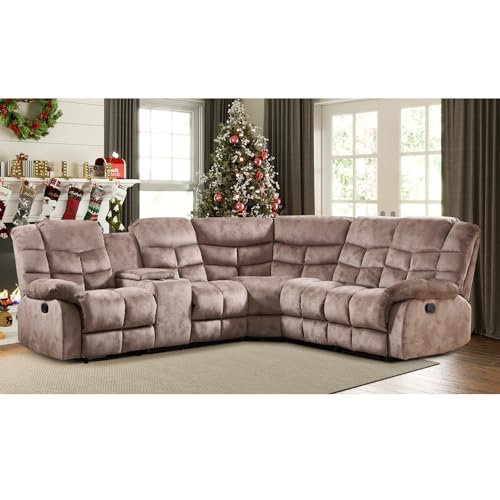
EBELLO Manual Reclining Sectional Sofa Set for Living Room, Soft Fabric Recliner Corner Sectional Couch with Center Console, Cup Holder and Storage, Brown
Check price on Amazon
Manual Recliner Sectional Sofa Set, Fabric L-Shaped Living Room Furniture Sets, Reclining Sectional Corner Couch with Drop-Down Table/Storage Console/Cup Holders for Home Office (Brown, Sectional)
Check price on Amazon
EBELLO Manual Reclining Sectional Sofa Set for Living Room, Soft Fabric Recliner Corner Sectional Couch with Center Console, Cup Holder and Storage, Grey
Check price on Amazon
EBELLO Fabric L-Shaped Reclining Sectional Sofa Couch for Living Room, Manual Recliner Oversized Sofa, with Padded Headrest, 2 Cup Holders, Storage Space, 5-Seater Home Furniture Set, Grey
Check price on Amazon
Dresegmt Manual Recliner Sectional Sofa for Living Room, Corner Couch with Flip Middle Backrest, USB Ports & Cup Holders, Grey Linen & Chocolate Leather, 5 Seater Sectional Couch
Check price on Amazon
EBELLO Faux Leather L-Shaped Reclining Sectional Sofa Couch, Manual Recliner Sofa, with Cup Holders, Storage Space, a Convertible Backrest 5 Seats Home Furniture Set for Living Room, Black
Check price on Amazon
EBELLO Manual Reclining L-Shaped Sectional Sofa Set, Soft Fabric Recliner Corner Couch with Center Console, Cup Holders and Storage, Recliner Sectional Couches for Living Room, Brown
Check price on AmazonFrequently Asked Questions
How does a manual recliner work on a sectional sofa?
A manual recliner uses a lever or pull handle connected to a spring-assisted mechanism. Pulling the handle releases a latch, and body weight plus spring tension pushes the footrest out and tilts the backrest. Pushing back on the footrest returns the seat to the upright position.
Do manual reclining sectionals need to be placed away from the wall?
Standard manual recliners need several inches of clearance behind the backrest to recline fully. Wall-hugger or zero-wall mechanisms slide the seat forward instead, so they can sit much closer to a wall. Always check the recline clearance specification before buying.
Which upholstery works best for a manual reclining sectional?
Performance fabric, top-grain leather, and tightly woven microfiber are common choices. Leather and performance fabric resist wear and are easier to wipe clean, while textured fabrics add warmth but need more frequent vacuuming in high-contact areas.
Can a manual reclining sectional fit in a small living room?
Yes, if you choose a compact layout such as a two-piece sectional with one recliner seat and a wall-hugger mechanism. Measure the available floor space, the recline clearance, and the doorway path before ordering.
Is a manual recliner less durable than a power recliner?
Not necessarily. Manual mechanisms have fewer electronic parts and no motor or wiring to fail. A well-built manual mechanism from a reputable brand can last many years with basic care, though the lever and spring assembly should be inspected periodically.
Ready to Choose Your Manual Reclining Sectional?
Review the recommended models above, confirm your room measurements and recline clearance, and select the layout and upholstery that match your household. A well-chosen sectional sofa with manual recliner can serve as the comfortable centerpiece of your living room for years.
Compare Recommended Models