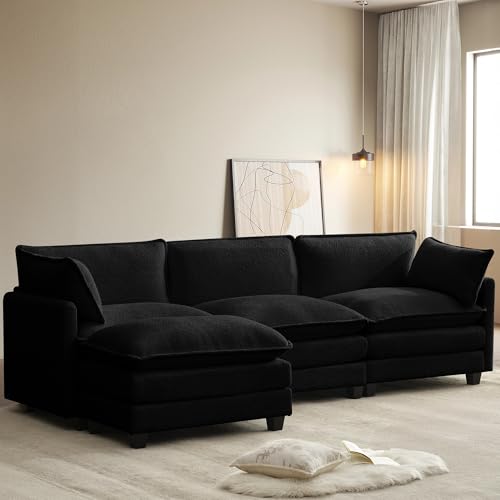
Why an L-Shaped Sofa Works in a Small Living Room
An L-shaped sofa, also called a corner sofa or sectional, solves a common small-room problem: how to seat more people without pushing furniture into the middle of the floor. The chaise or return section wraps along a wall or floats as a room divider, which frees up the center of the room for movement.
Compared with a standard three-seater plus a separate armchair, an L-shaped configuration often seats the same number of people while using less floor area overall. The continuous seating line also creates a natural conversation zone, which makes a compact room feel intentional rather than crowded.
If you are comparing open configurations, it helps to understand the difference between a fixed sectional and a flexible setup. A modular sofa lets you rearrange sections and add or remove the chaise when your room changes, which is a strong advantage in apartments and rental homes.
Small-space designs also benefit from smart companion furniture. Pairing an L-shaped sofa with a slim narrow side table or a small sofa chair for the living room keeps the seating flexible without blocking walkways.
Start With Measurements, Not With Style
Before browsing styles, measure the room. Small living rooms fail when the sofa is chosen first and the layout is forced to fit around it. Use this three-step process:
- Measure the walls: Record the length of every wall where the sofa could sit, including door swing clearance and radiator positions.
- Map the walkway: Leave at least 18 inches of clearance between the sofa and other furniture, and 30 to 36 inches along main traffic paths.
- Mark the footprint: Use painter's tape on the floor to outline the sofa's footprint. Live with it for a day to confirm the room still feels open.
A compact L-shaped sofa usually measures about 70 to 90 inches along its longest side, with a chaise depth of roughly 30 to 36 inches. Anything larger starts to dominate a room under about 120 square feet.
Choosing the Right Configuration
The shape of your room decides which configuration works best. The table below compares the most common options for compact spaces.
| Configuration | Best For | Key Consideration |
|---|---|---|
| Left-facing chaise | Rooms where the focal wall is on the left side | Confirm the chaise does not block a doorway |
| Right-facing chaise | Rooms where the focal wall is on the right side | Check window and radiator clearance |
| Reversible chaise | Rentals and rooms that may be rearranged | Look for a secure locking mechanism |
| Removable ottoman section | Very small rooms and multi-use spaces | Ottoman can double as extra seating |
| Corner with storage | Homes that need hidden blanket or toy storage | Verify the lid or drawer opens fully |
If you want built-in practicality, a small sectional sofa with storage keeps blankets, remotes, and kids' items out of sight. For rooms that need to host overnight guests, a pop-up sleeper sofa with chaise combines daytime seating with a fold-out bed.
Placement Strategies That Open Up the Room
Where you place the sofa matters as much as its size. Try these approaches:
Float the sofa to define zones
In an open-plan or studio space, placing the back of the L-shaped sofa toward the dining or kitchen area creates a visual boundary without building a wall. This works especially well with low-back designs that do not block sightlines.
Anchor the corner, not the center
Push the corner of the L into the room's least-used corner. The chaise then extends along the wall, keeping the center of the room clear. Avoid placing the long side across a window if it blocks light.
Use the chaise as a room divider
In a long, narrow room, angle the chaise outward to separate the seating area from a workspace or play area. A room divider can reinforce this boundary if you need more privacy.
Keep legs visible
Sofas with raised legs let light and floor color show beneath them, which makes the room feel larger. Bulky skirts and solid bases visually shrink a small space.
Small-Room Layout Checklist
- Confirm at least 18 inches of clearance around the sofa.
- Keep the main walkway at least 30 inches wide.
- Place the chaise opposite the TV or focal point.
- Avoid blocking windows, radiators, and door swings.
- Choose a sofa with visible legs to show floor space.
- Test the footprint with tape before ordering.
Materials and Upholstery for Compact Spaces
Light and mid-tone fabrics reflect light and make a small room feel airier. Dark colors can work beautifully, but they absorb light and can make a tight corner feel heavy. Consider these practical points:
- Performance fabric: Tight-weave performance upholstery resists stains, pilling, and everyday wear — a smart choice for family rooms.
- Removable covers: Washable, removable covers extend the life of the sofa and simplify cleaning.
- Pet-friendly options: A pet-friendly sectional uses scratch-resistant weaves and easy-clean surfaces.
- Sustainable choices: If eco-conscious materials matter to you, review this sustainable fabrics guide before you decide.
- Protection: A fitted slip cover adds a layer of defense and lets you refresh the look seasonally.
Leather is durable and easy to wipe clean, but it can feel visually heavy in a very small room. If you prefer leather, choose a lighter tan or a streamlined silhouette; a tan leather sofa tends to feel warmer and less imposing than dark shades.
Comfort Details That Matter in a Small Sofa
Small sofas still need to be comfortable. Pay attention to these details:
- Seat depth: 20 to 22 inches suits most adults; deeper seats feel loungier but take more floor space.
- Seat height: Around 18 inches is comfortable for most people and makes getting up easier.
- Cushion fill: High-resilience foam holds its shape; a down-filled sofa feels softer but needs regular fluffing.
- Frame: Solid hardwood or engineered hardwood frames with reinforced joints last longer than particleboard.
- Back support: A slightly reclined back is more comfortable for long lounging sessions than a rigid upright back.
Styling a Small L-Shaped Sofa
Styling should enhance space, not fill it. Keep the palette cohesive and the accessories purposeful:
- Use two to four throw pillows in coordinated tones rather than a pile of mismatched cushions.
- Choose a round or oval coffee table to soften the hard lines of an L-shaped sofa and improve flow.
- Add a floor lamp or a slim table lamp instead of bulky overhead lighting.
- Hang artwork or a mirror above the sofa to draw the eye upward and add perceived height.
- Keep the floor visible with a low-pile rug that extends slightly beyond the sofa's front edge.
A well-styled small sofa can look as polished as a large one. The goal is balance: enough accessories to feel warm, but not so many that the room feels cluttered.
Common Mistakes to Avoid
- Buying before measuring: Always tape out the footprint first.
- Choosing a chaise that blocks a walkway: The chaise should extend into open space, not into a traffic path.
- Ignoring door swing: Confirm the sofa fits through the door and around hallway corners during delivery.
- Overfilling the room: A sofa plus too many side tables and accessories defeats the purpose of a compact design.
- Skipping the return policy check: Confirm delivery, assembly, and return terms before ordering online.
Frequently Asked Questions
What is the best L-shaped sofa size for a small living room?
A compact L-shaped sofa typically measures between 70 and 90 inches on the longest side with a chaise depth of 30 to 36 inches. Measure your room and leave at least 18 inches of walking clearance around the sofa before choosing a configuration.
Should the chaise go on the left or right side?
Place the chaise on the side that faces the focal point of your room, such as the TV or fireplace, and that keeps the main walkway open. In narrow rooms, a reversible chaise offers flexibility if you rearrange later.
Can an L-shaped sofa work in an apartment living room?
Yes. Apartment-friendly models use slim arms, low backs, and removable ottomans to reduce visual bulk. Choose a sofa with legs to create visible floor space beneath it, which makes the room feel larger.
What fabric works best for a small living room sofa?
Light to mid-tone performance fabrics reflect light and hide everyday wear. Tight-weave upholstery resists pilling and is easier to clean. Removable, washable covers are a practical choice for homes with kids or pets.
How do I keep a small room from feeling crowded?
Keep the center of the floor clear, choose a sofa with visible legs, limit accessories, and use a light color palette. Mirrors and vertical artwork also help the room feel taller and more open.
Final Thoughts
An L-shaped sofa is one of the most effective ways to add comfortable seating to a small living room — provided the size, configuration, and placement are planned around the space. Measure first, tape out the footprint, choose a reversible or modular design if flexibility matters, and keep the styling light.
With the right approach, a compact corner sofa can seat more people, define the room's function, and still leave the floor open. Use this guide as your checklist, and you will be ready to compare models with confidence.