
Small Reclining Sectional Sofas for Small Spaces
Compact comfort without the footprint. Learn how to choose a reclining sectional that fits tight rooms, delivers real relaxation, and holds up to daily life.
EXPLORE THE GUIDEWho this guide is for: If you live in an apartment, a narrow townhouse, or a compact family room, you already know that a standard reclining sectional can swallow the entire floor plan. This guide walks you through the small-space models that actually work — how they are built, what to measure, which mechanisms to prioritize, and how to style them so the room still feels open. By the end, you will know exactly which configuration fits your space and how to commit with confidence.
Why Choose a Small Reclining Sectional?
A small reclining sectional solves a specific problem: it combines the seating capacity of a sectional with the lounge function of a recliner, without demanding the floor area of a full-size model. For renters and homeowners with limited square footage, that combination is hard to beat. You get a corner seat, a chaise-like recline, and often a compact loveseat-scale footprint that leaves room for a coffee table and a walkway.
The trade-off is that small models compress the mechanism, cushion depth, and frame geometry. Not every petite recliner is built to the same standard. Entry-level models often use shorter stroke mechanisms and thinner foam, while mid-range and premium tiers invest in smoother gliding hardware, denser seat cores, and tighter upholstery. Understanding those differences before you shop is the difference between a sofa that lasts and one that sags within a year.
Key Factors Before You Buy
Small-space reclining sectionals are engineering compromises, and the best choice depends on which compromise you can live with. Work through the factors below in order — measurement first, then mechanism, then material and configuration.
1. Measure the room, not just the wall
Most buyers measure the wall and stop there. For a reclining sofa, the critical dimension is the depth when fully extended. Traditional recliners need 18 to 24 inches of clearance behind the sofa, plus the seat extension in front. Wall-hugger and zero-wall mechanisms change that math entirely: they slide the seat forward on a track, so the backrest stays close to the wall and the front projection is more predictable. In a room under 150 square feet, this is usually the deciding factor.
2. Choose the right recline mechanism
Manual lever and push-back mechanisms are the simplest and most reliable in compact frames. Power reclining adds smooth motion and often includes adjustable headrests and lumbar support, but it introduces a motor, wiring, and a power source requirement. If the sofa will sit against a wall with no outlet nearby, a manual wall-hugger is the practical choice. For a deeper look at power options, see our guide to a power headrest reclining sectional, which explains how headrest articulation changes comfort in smaller seats.
3. Match the configuration to your room shape
The most common small-space layouts are L-shaped sectionals with a chaise on one end, and two-piece modular units that can be separated. A right- or left-facing chaise lets you control which side blocks the walkway. If your room is long and narrow, a straight two-seat reclining configuration may actually work better than a corner unit. For narrow footprints, a narrow recliner sofa is worth comparing before you commit to a sectional, since it removes the corner footprint entirely.
4. Prioritize frame and cushion quality
In compact sofas, the frame carries more stress per inch than in large models. Look for kiln-dried hardwood or reinforced engineered wood, corner-blocked joints, and sinuous or pocket-coil suspension. Seat cushions should be high-resilience foam wrapped in fiber, ideally with a density rating stated by the manufacturer. Entry-level tier models often use lower-density foam that compresses quickly; mid-range and premium tiers typically hold their shape longer. If you plan to use the sofa daily, the cushion core is the single most important specification.
5. Select upholstery for real life
Tight-weave performance fabric and top-grain leather are the two most forgiving choices for high-use reclining sofas. Both resist abrasion and clean up well. Velvet and bouclé look beautiful but show compression marks in reclining seats, where fabric stretches over the mechanism. If pets or children share the room, a removable, washable cover is a strong advantage — our overview of slip covers covers the fit options that work with reclining frames.
Recommended Small Reclining Sectionals for Compact Rooms
⚠️ AFFILIATE DISCLOSURE: This website contains affiliate links. As an affiliate Associate, we earn from qualifying purchases. If you make a purchase through these links, we may receive a small commission at no additional cost to you. Read our full affiliate policy.

EBELLO Manual Reclining Sectional Sofa Set for Living Room, Soft Fabric Recliner Corner Sectional Couch with Center Console, Cup Holder and Storage, Brown
Check price on Amazon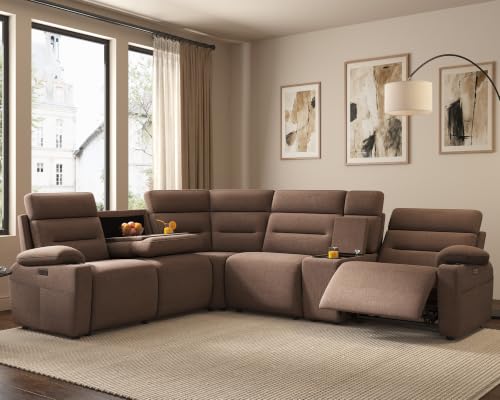
AMERLIFE L-Shaped Power Reclining Sectional Sofa with Dual Consoles, Brown | Dual Power Reclining Seats, Fixed & Flip-Back Consoles, Cup Holders, USB, Hidden Storage, Linen Upholstery, Modular Seating
Check price on Amazon
EBELLO Faux Leather L-Shaped Reclining Sectional Sofa Couch, Manual Recliner Sofa, with Cup Holders, Storage Space, a Convertible Backrest 5 Seats Home Furniture Set for Living Room, Black
Check price on Amazon
EBELLO Fabric L-Shaped Reclining Sectional Sofa Couch for Living Room, Manual Recliner Oversized Sofa, with Padded Headrest, 2 Cup Holders, Storage Space, 5-Seater Home Furniture Set, Grey
Check price on Amazon
Vipbear Pull Out Sofa Bed Sectional Sleeper Sofa with Reclining Backrest & Storage, Corduroy Pullout Modular Sectional Couches with USB Charging, L Shaped Convertible Couch Bed for Apartment, Green
Check price on Amazon
Power Reclining Sectional Sofa, Leather L Shaped Recliner Couch with LED Lights, Storage Console, Cup Holders & USB Ports, 6 Seat Home Theater Seating Sofa for Living Room Furniture(White)
Check price on Amazon
Reclining Sectional sofa, Reclining Sofa, Leather Sectional, Beige Brown | Power Reclining Sofa with Storage & USB, Adjustable Headrest & Cup Holders, Leather Sectional Couches for Living Room
Check price on Amazon
Power Reclining Sectional Sofa Set, Zero Gravity Recliner Couch with USB | Premium Fabric, USB Port 2 Console Storage 4 Cup Holders
Check price on AmazonBest Configurations for Small Spaces
Once you know your room dimensions, the next decision is layout. These three configurations cover most compact living rooms and apartments, and each solves a different spatial problem.
L-shaped sectional with a single chaise
The most versatile layout for a small living room. The chaise replaces a separate ottoman and creates a natural lounge zone, while the shorter arm keeps the walkway clear. Place the chaise on the side away from the main traffic path so the reclining seat does not obstruct movement. Models with a reversible chaise give you flexibility if you rearrange the room later.
Two-piece modular reclining sectional
Modular units split into separate pieces, which matters for delivery and for rooms with awkward corners. You can separate the sections into a sofa and a standalone recliner when guests visit, then push them back together for daily use. This flexibility is why modular designs are popular in studio apartments and open-plan spaces. If you are furnishing a studio, our modern sofa set for small space guide pairs well with this configuration.
Reclining loveseat with a corner wedge
A compact reclining loveseat plus a corner wedge gives you the sectional footprint without the depth of a full L-shape. It suits rooms under 120 square feet where a chaise would block the entry. The trade-off is less lounge surface, so this configuration works best for one or two people. For a direct comparison, our loveseat sofa beds for small spaces guide covers the multi-function alternatives.
Configuration Comparison at a Glance
| Configuration | Best For | Tier Guidance | Space Consideration |
|---|---|---|---|
| L-shaped with chaise | Daily lounging, one or two people | Mid-range to premium | Chaise adds depth; keep walkway clear |
| Two-piece modular | Apartments, flexible layouts | Essential tier to mid-range | Splits for delivery and rearrangement |
| Reclining loveseat + wedge | Rooms under 120 sq ft | Starter tier to mid-tier | Smallest footprint; less lounge surface |
| Wall-hugger reclining sectional | Narrow rooms with a wall anchor | Mid-range to high-end tier | Minimal rear clearance required |
Materials and Durability
In a compact sofa, every component works harder. The reclining mechanism cycles more often per square inch of seating, the foam compresses under concentrated load, and the upholstery stretches over moving joints. Durability is not a luxury in this category — it is the baseline expectation.
Leather remains the most durable surface for reclining furniture because it resists abrasion and does not pill. Top-grain leather in a mid-range or premium tier will outlast most fabric covers in daily use. If you prefer fabric, look for performance weaves with a high rub count and a tight construction. Our guide to leather sofa covers explains how to protect leather surfaces without trapping moisture.
The mechanism itself deserves scrutiny. Entry-level tier models often use lighter-gauge steel and plastic bushings; mid-range and premium tiers use heavier steel, smoother glides, and reinforced mounting plates. If the sofa will be used by multiple people daily, invest in the higher mechanism tier. It is the component most likely to fail first and the hardest to replace.
Styling a Small Reclining Sectional
A reclining sectional already occupies visual weight in a small room. The goal is to keep the surrounding decor light and functional. Choose a low-profile coffee table or a pair of narrow side tables instead of a large central piece, and use a rug that extends slightly beyond the sofa footprint to define the zone without crowding it.
Throw pillows should be limited to two or three so they do not interfere with the recline motion. Stick to a restrained palette: neutrals with one accent tone reads calmer in a tight space than a busy mix. If you want to add contrast, our guide to modern black and white throw pillows shows how a high-contrast pairing can work without overwhelming the room. Avoid tall floor lamps directly beside the reclining end — a wall-mounted or corner lamp keeps the swing path clear.
Common Mistakes to Avoid
- Skipping the extended-depth measurement. The sofa may fit the wall but block the doorway once reclined. Measure the fully extended footprint, not just the closed position.
- Choosing power recline without an outlet plan. Power models need a nearby power source and clearance for wiring. Confirm the outlet location before ordering.
- Ignoring delivery access. A sectional that fits the room may not fit the stairwell. Check doorway width and turning radius, and ask about split delivery.
- Underestimating cushion density. Thin foam in a reclining seat compresses quickly. Ask for foam density or look for pocket-coil cores in the tier you are considering.
- Over-styling the recline path. Oversized pillows and tight rug placement can block the footrest. Leave the swing zone clear.
Frequently Asked Questions
How much floor space does a small reclining sectional need?
Plan for roughly 6 to 8 feet of width and at least 3 feet of clearance in front of the reclining seats. Wall-hugger and zero-wall mechanisms cut that front clearance significantly, which matters in tight rooms.
Are wall-hugger reclining sectionals worth considering for small rooms?
Yes. Wall-hugger designs slide the seat forward instead of tilting the backrest back, so you can place the sofa just a few inches from the wall. They are a practical choice when every foot of depth counts.
What fabric works best for a compact reclining sectional?
Tight-weave performance fabric and top-grain leather are both solid choices. They resist daily wear, clean up well, and hold their shape in high-use zones without needing frequent professional care.
Can a small reclining sectional fit in an apartment?
Yes, especially modular and left- or right-facing configurations. Measure the doorway and turning radius before ordering, and choose a model with removable backs or split delivery if stairwells are narrow.
Final Takeaway
A small reclining sectional is the right choice when you need lounge function without the floor area of a full-size sofa. Measure the extended depth first, choose a wall-hugger or modular configuration that matches your room shape, and invest in the mechanism and cushion tier that matches how often you will use it. Do those three things, and the sofa will serve the room for years rather than months.
Ready to compare models? The recommended section above lists compact reclining sectionals selected for small-space use. For buyers who want a broader overview before narrowing down, our sectional sofas with chaise for small spaces guide covers the wider category, and our small recliners page covers single-seat alternatives if a sectional is too large for your layout.